
Everything you need to know about Polish names
Table of Contents
History of Polish Names
The Oldest Polish names are of Slavic origins. Firstly there were so-called common names. They were not abstract or made up, but rather connected to common things that were familiar to people of that time. They mostly referred to:
- occupation: Kowal – blacksmith
- place (of origin, of living, etc.): Lasota – the one who lived in the forest (forest-las)
- personal features: Charnula- the one who had black hair (black- czarny) or Białowąs – someone who had a white mustache (white- biały, mustache-wąs)
- animal: Lis- fox
- plant: Jawor- sycamore
The majority of common names did not survive to our time. Some disappeared, while others lost or shifted their function—for example, becoming surnames (just as the former name Kowal became the surname Kowalski, or Jawor became Jaworowicz). Only a few still exist in their primary forms, mainly those related to plants, such as Róża (Rose) or Kalina (Viburnum).
The second group of oldest types of names was double-barrelled names. These are also very old; some even date back to Proto-Slavic times and were generally used by the upper classes (for example, the name Bolesław—from bardzo + sławny, meaning ‘very famous’—was used exclusively within the royal family until the 15th century). Peasants were often called by common names. The majority of these compound names carried meaning; they consisted of two words merged into one. Usually, they had a “wishing function”: their meaning was expected to shape the bearer’s future or characteristics (e.g., Radogost—from radosny + gościnny, meaning ‘cheerful’ + ‘hospitable’). Many have remained to this day and are still popular, such as Sławomir, Kazimierz, or Bogdan.
In ancient times, names were not given to a child immediately after birth, as is the custom now. In pagan Slavic culture, a name had to be earned over time. A child was usually given a name at the age of seven. For boys, this typically occurred during a ceremony called postrzyżyny (ceremonial hair cutting). Along with the haircut, the child received a name and became an official part of the family and society, transitioning from the mother’s to the father’s guidance.

There is no agreement among scholars as to whether the child was officially given a name that he had already been using until that time, or if a new one was given. Regarding the latter view, the most common idea is that children, until the ceremonial hair cutting, were called by some kind of subsidiary name like “Niemój” (nie + mój = not + mine). This had a magical function and served as a shield against demons and ghosts. By demonstrating the child’s insignificance, the aim was to avoid attracting bad spirits. There is surely also an unintentional psychological aspect involved—the death rate among newborns and small children was very high at that time. Postrzyżyny was a ceremony mainly for boys; girls’ names were usually given more privately, without such elaborate protocol.
Keeping postrzyżyny and old Slavic rituals in mind may help us remember the Polish phrase “Jak masz na imię” better, as it makes much more sense in this context. In Polish, we do not ask, as in the majority of other European languages, “What is your name?” Instead of the verb ‘to be’, in Polish we use the verb ‘to have’; in this sentence, the name is not something that just ‘is’, it is something that we have or own.
An interesting fact about old Slavic culture is that no names referred to Pagan Gods; most likely, this was a taboo subject and a sacred sphere not to be brought up in common, everyday situations.
The spread of Christianity on Polish lands (after 966) brought with it Christian names, which, with time, started slowly displacing old Slavic ones. New names came from the Old and New Testaments; names of Apostles, Saints, or Martyrs (Jan, Mateusz, Cecylia, Urszula) were especially popular. It was never a practice to give children the religious name Jesus (Jezus), and up to the 19th century, Mary (Maria) was extremely rare.
Christian names are still very popular; they continue to be the largest group among modern Polish names, but usually, they do not carry religious connotations anymore.
Another category of Polish names is the names inspired by culture– mainly from literature. We have a few of them which came into usage in different periods, for example, Oskar or Malwina were coming from The Works of Ossian; Grażyna was the name created and used by Polish poet Adam Mickiewicz in one of his works.
The XX century started the period of loanwords names. Many new names (or modified ones) appeared as a result of the influence of English, German or Russian. Examples of such names are Żaneta, Nikola, and Dżesika– there is a variety of spelling, mainly depending on the wish of the parents who are giving it to the baby.
Grammer Rules of Polish Names
One of the easy things in Polish is the fact that by knowing the name we can usually guess the gender of the bearer. Names ending with -A is in 99 % female names (with exception of foreign names and very few rare male ones like Kosma or Dyzma). It is a good tip to remember the gender of nouns in general. The vast majority of feminine nouns will end with -A, the same as Polish girls’ names. This rule is very visible in pairs of names which we have several in Polish, the same name may have two versions:
- Kamil (masculine) Kamila (feminine)
- Karol (m) Karolina (f)
- Bogusław (m) Bogusława (f)
Unfortunately, this rule only applies when the name stands in Mianownik– Nominative, primary case. If it’s being declined by any other case it can have a variety of endings and -A is no longer reserved for feminine ones. Take a look:
To jest Maciej a to jest Anna.(Nominative- Mianownik)
Nie ma Maciej A i nie ma AnnY. (Genitive- Dopełniacz)
Diminutives for Polish Names
Polish loves diminutives. It is not a surprise that we have many possibilities to use the diminutive form regarding Polish names as well. Let’s take a look at general rules and ways how we can do that:
- by shortening the name: Alicja – Ala, Elżbieta– Ela. Maksymilian– Maks, Tomasz– Tomek, Stanisław– Staś, these may seem quite obvious but we have a bit more complicated, perhaps ridiculous as well: Aleksander – Olek, Joanna– Asia, Katarzyna– Kasia
- by adding -ka and/or -usia to feminine names: Maja– Majka- Majusia, Dorota – Dorotka,
- by adding -uś, -iś, -yś to male names: Krzysztof– Krzyś, Jacek– Jacuś and -ek Jan-Janek, Zbigniew– Zbyszek or rarely -o: Ryszard – Rysio
What is interesting is that diminutive forms of names are not used only to address children or to reflect very close relationships, as it may seem. Poles very often use only diminutive versions of their names in everyday life, sometimes even with strangers. It is very likely that a newly met girl will introduce herself to you as Kasia instead of Katarzyna, or that a boy will always sign emails as Tomek instead of Tomasz. This is a cultural nuance and must be “felt by intuition” or simply learned through practice, as some names will never work in a diminutive form for adult strangers, while others are hardly ever used in their basic form. If you address a newly met Anna as Ania, it will most probably be completely fine; however, if you try the same with Karolinka instead of Karolina, it will be quite strange. This stems from the fact that diminutives of some popular names are used so often that they virtually lose their diminutive character and are perceived as standard names without the associated emotional baggage.
My favorite and as well very Polish connection is diminutive name form combined Mr or Mrs (Pan, Pani). By doing so we will receive so interesting, and rather very odd for foreigners, constructions as Pani Zosia (from Zofia) or Pan Remek (from Remigiusz). Most likely such combinations will be used in a situation when you are maintaining with someone rather formal relation (don’t want to resign from using formal Pan/Pani expressions) but at the same time, you want to show your sympathy or kindness towards the person. As an illustration: I’m always calling the administrator of the building in which I live Pani Hania (from Hanna). I do so because she is much older than me, therefore I want to keep formal and in this case, showing some respect form Pani, but at the same time I see her everyday for a couple of years already, she is not a stranger to me anymore and by using Hania I feel like I’m showing my warm feelings towards her.
Popular Names in Poland
The popularity of names changes every couple of years. A few years ago there was a period when names of foreign origins were very popular, for example, Nikola or Oliwia. Nowadays there is a trend to come back to older names like Antoni or Franciszek.
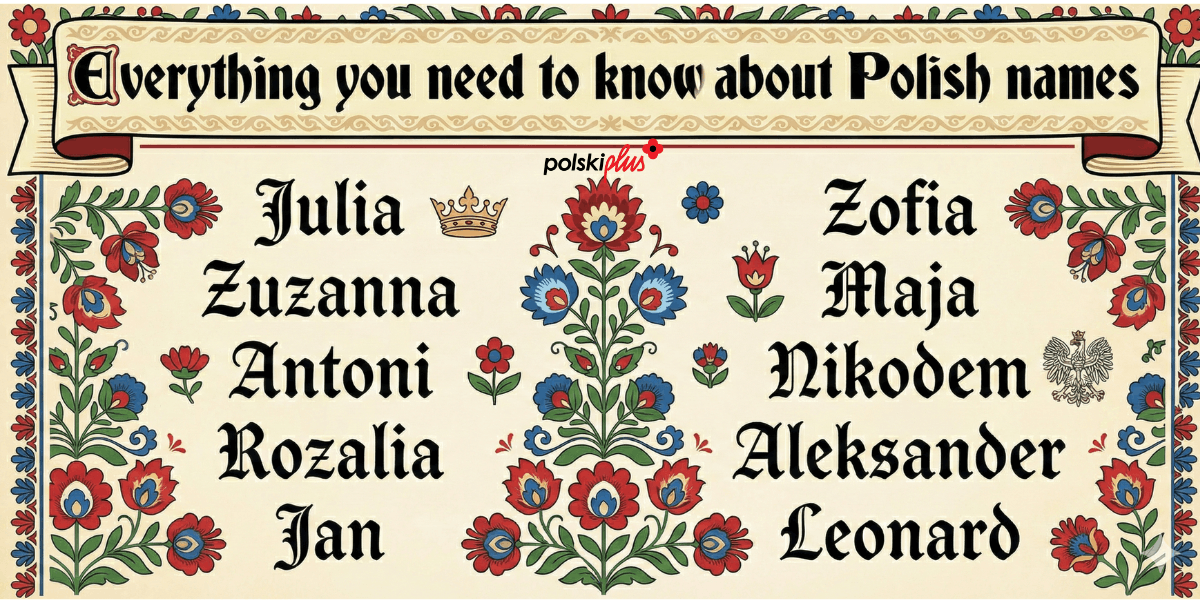
- In 2020 most popular names given to girls were: Julia and Zuzanna, to boys Antoni and Jan.
- In 2021, the most popular Polish names for boys were same as the previous year, but Zuzanna and Zofia were top names for girl.
- In 2022, Jan and Aleksander were the top names for boys, Zofia and Zuzanna were the most popular girl names in Poland.
- In 2023, Nikodem and Antoni were the top names for boys, Zofia and Zuzanna were the most popular girl names for Polish families.
- In 2024, Nikodem and Antoni were the top names for boys, Maja and Zofia were the most popular girl names.
- In 2025, Antoni and Zofia were the most popular children names in Poland.
You can view the lists here at dane.gov.pl website, the most popular Polish girl and boy names in Poland
When I was looking at my family tree, the name Antoni and Rozalia were present almost in every generation for dozens of years. In the past it was quite popular to name the first son after the father as well, now it is quite rare due to practical reasons.
What is Name Day – IMIENINY?

A name day (imieniny) is a custom connected to Roman Catholic and Eastern Orthodox church and originated with the Christian calendar of saints. It is celebrating a day of the year that is associated with one’s given name. Whose name day is today can be easily checked as almost every calendar has such information, it is also part of everyday radio or tv morning news.
A few decades ago name day was celebrated in Poland even more festive than a birthday. Nowadays it changed and it is mostly being celebrated by a bit older generation. What might have had an influence on such a shift was the growing popularity of Facebook and similar social platforms. Before people didn’t know the birthday dates of more distant friends or colleagues therefore they celebrated and prepared gifts and wishes for name days which could be easily checked in the calendar. With Facebook becoming popular, birthday dates became public knowledge and name-days are slowly sinking into the shadows of forgotten traditions.
In 2015 laws in Poland have changed. Before it was not possible to give a child a foreign name if both parents were Polish. The name could have been of foreign origin but not foreign spelling or pronunciation, so it wasn’t allowed to name daughter Sophie (Zofia was ok though), not Ann but Anna, not Pedro but Piotr. After the change parents now have more possibilities to choose from, fully foreign names are allowed. Parents can use their imagination with exception of offensive or shaming names.

You may also like
1 Comment